You may have walked by a traditional yoga studio and heard a roomful of people breathing together, moving together like a well-oiled machine. If so, you probably saw Ashtanga Vinyasa Yoga. It’s dynamic, deeply physical, and has a distinctive, rhythmic intensity. Unlike modern flow classes, where the sequence shifts based on the teacher’s mood, Ashtanga sticks to an exact, uncompromising set of postures practiced in the same order every single time.
At first glance, it can look pretty intimidating. You hear complex Sanskrit names, watch people float through effortless-looking transitions, and realize there is a massive sequence to memorize. But that exact structure is what turns a physical workout into a moving meditation. You aren’t just trying random poses; you’re building a reliable, lifelong daily practice. The Ashtanga Vinyasa Primary Series is the bedrock of this system. It is designed to build foundational strength, flush out physical tension, and steady a noisy mind. Whether you are completely new to the mat or curious about what makes this method so enduring, here is a practical look at how it all works.
What Is Ashtanga Vinyasa Yoga?
The core of Ashtanga Vinyasa Yoga is the link between breath and movement in a seamless flow. The word “Vinyasa” refers to this exact coordination entering, holding, and leaving a posture on the precise ins and outs of the breath. You don’t hang out in a stretch for minutes at a time; you glide fluidly through a carefully organized blueprint. What really sets Ashtanga apart is its progressive nature:
- Fixed Sequences: You master one set of postures before moving to the next.
- Breath Anchor: The breath dictates the speed of the movement, not the other way around.
- Self-Paced Practice: While taught in guided classes, it is traditionally practiced “Mysore-style,” where students move through the sequence at their own pace while a teacher provides individual adjustments.
The Primary Series serves as the entry point for every practitioner, establishing the physical stamina and mental discipline required for everything that follows.
Understanding the Primary Series (Yoga Chikitsa)
In Sanskrit, the Primary Series is known as Yoga Chikitsa, which translates to “yoga therapy.” That name surprises a lot of people because the practice feels anything but gentle. However, the “therapy” refers to its ability to realign the spine, detoxify the physical body, and recalibrate the nervous system after years of poor posture or stress. Don’t let the word “primary” fool you into thinking it’s a lightweight beginner’s routine. The Primary Series is a comprehensive physical challenge. It asks for serious hamstring length, hip opening, core stability, and shoulder endurance. The point, however, isn’t to force your body into every shape on day one. You learn it brick by brick, memorizing the order, mastering the transitions, and respecting your current physical boundaries.
Key Benefits of Building a Regular Practice
Why commit to the exact same sequence day after day? The predictability is where the magic happens. When your body stops wondering what posture comes next, your mind finally settles down.
Physical benefits: builds core & upper body, opens tight hips & hamstrings, and improves balance & posture.
Mental & neurological benefits: enhances focus and single-pointed concentration, reduces stress through breath-anchored movement, and builds self-discipline and emotional resilience.
Over time, small shifts begin to happen. A forward fold that felt impossible in month one suddenly feels comfortable by month six. Your breath stays calm even when your muscles are burning. That resilience directly translates into how you handle everyday stress off the mat.
Key Ashtanga Vinyasa Yoga Poses in the Primary Series
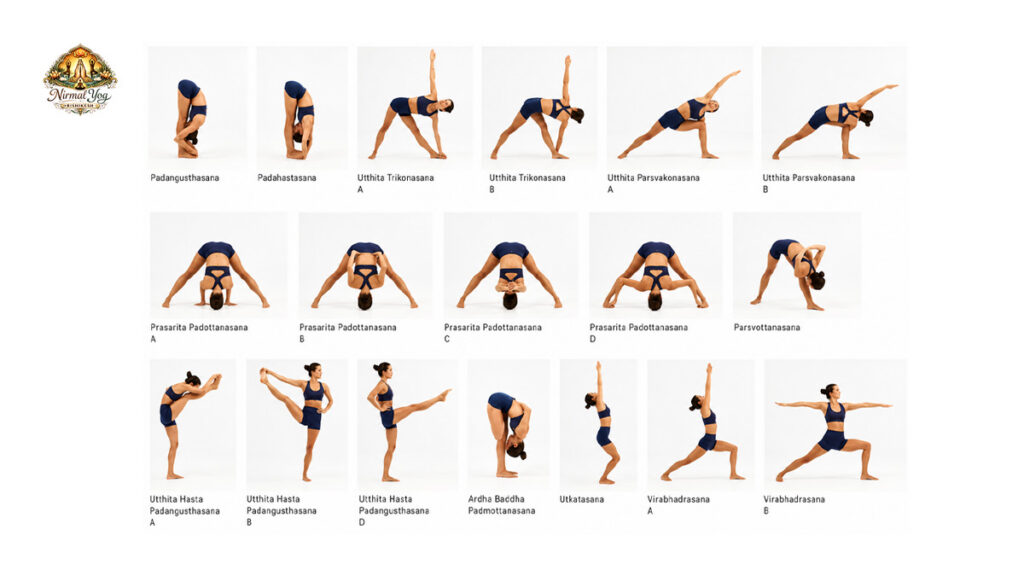
The Primary Series contains over 40 postures, taking you through standing balance, heavy seated folding, deep twisting, and inversion work.
Standing and Balancing Postures
After warming up, the practice transitions into standing balance poses like Utthita Hasta Padangushthasana (Extended Hand-to-Big-Toe Pose). Variations follow, alongside Utthita Parshvasahita, Ardha Baddha Padmottanasana, Utkatasana (Chair Pose), and Virabhadrasana A and B (Warriors I and II). These build foot stability, ground the lower body, and open the hips.
Seated Forward Bends
The heart of the Primary Series takes place on the floor. It begins with Dandasana (staff pose) and moves through intensive hamstring stretches like Paschimattanasana, Ardha Baddha Padma Paschimattanasana, and Janu Shirshasana. These poses calm the central nervous system while working deep into the back body.
Twists and Core Engagement
To keep the spine mobile, the sequence integrates twisting variations of Marichyasana. Shortly after comes Navasana (Boat Pose), practiced for five repetitions, a notorious segment that builds deep abdominal strength and hip flexor endurance.
Arm Balances and Complex Positions
As you move deeper, the physical demands scale up. Poses such as Bhuja Pidasana (Shoulder-Pressing Pose), Kurmasana (Tortoise Pose), Supta Kurmasana, Garbha Pindasana, and Kukkutasana challenge the strength of the arms, the access to hips, and balance. These are sophisticated moves that practitioners spend years perfecting.
Hip-Opening, Backbends, and Finishing
The floor work concludes with deep hip openers such as Baddha Konasana and Upavistha Konasana and supine leg stretches like Supta Padangushthasana. The sequence includes strong backbends such as Urdhva Dhanurasana (Wheel Pose) and Chakrasana (backward roll) and then cools down with inversions and deep rest.
How a Traditional Class Is Structured
Every Ashtanga practice, regardless of how far you get into the sequence, follows a clean, predictable arc:
- Opening: Chanting the traditional Ashtanga opening mantra to center focus.
- Sun Salutations: Five rounds of Surya Namaskar A and three to five rounds of Surya Namaskar B to build internal heat.
- Standing Sequence: Postures designed to establish grounding and balance.
- Primary Series (Floor Work): Seated folds, twists, arm balances, and backbends.
- Finishing Sequence: Shoulderstands, headstands, and quiet breathing to restore the nervous system.
- Savasana: Final relaxation to integrate the physical effort.
Is Ashtanga Vinyasa Suitable for Beginners?
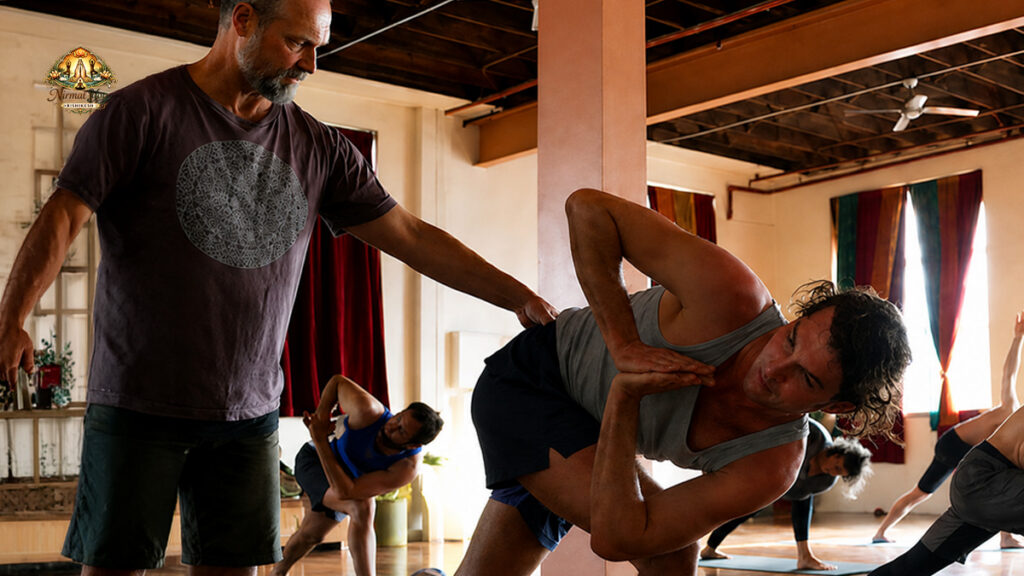
The short answer is yes, provided you approach it with the right mindset. You do not need to perform every pose in the Primary Series on your first day. In a traditional setting, a good teacher will stop you at a posture that presents a safe challenge, asking you to complete the finishing sequence from there. As your body adapts, they “give” you the next pose.
- Ditch the Ego: Don’t worry about what the person on the mat next to you is doing.
- Work with Modifications: Bend your knees, use straps, or shorten holds when needed.
- Patience Over Speed: It can take years to move through the full Primary Series comfortably. That is completely normal.
The ultimate lesson of Ashtanga isn’t getting your head to your knees, it’s learning how to stay present when things get uncomfortable.
Learning Ashtanga Vinyasa Step by Step
If you’re ready to step onto the mat, keep your initial goals simple. Focus first on breathing evenly through your nose. Learn the pattern of Surya Namaskar A and B so well that you can do them at home without looking at a screen. Once that heat is accessible to you, gradually layer on the standing postures. For those wanting to take a deep dive into the philosophy, alignment, and history, attending an yoga teacher training in India offers an incredible, immersive way to learn straight from experienced lineage holders. But whether you train abroad or drop into a local neighborhood studio, the rule remains the same: practice safely, stay consistent, and listen to your body.
Final Thoughts
Ashtanga Vinyasa Yoga can look intense from the outside, but strip away the complex poses, and it’s just a tool for self-awareness. You roll out your mat, connect movement to your breath, and show up honestly with whatever energy you have that day. You don’t need flexible hamstrings or perfect balance to begin you just need the willingness to show up and try. Start where you are, go at your own pace, and let the practice unfold naturally over time.
Frequently Asked Questions
It is a structured, breath-centric style of yoga where practitioners move through a set sequence of postures. Each movement is synchronized with an inhale or exhale, creating a dynamic, continuous flow that builds strength, internal heat, and focus.
Known traditionally as Yoga Chikitsa (Yoga Therapy), it is the foundational sequence of the system. It consists of sun salutations, standing poses, seated forward folds, twists, core work, backbends, and inversions meant to realign and detoxify the body.
The full series contains roughly 42 core postures (asanas), excluding the individual movements of the Sun Salutations and transitions. These range from simple standing stretches to advanced arm balances and deep forward folds.
Yes, as long as it is taught progressively. Beginners are not expected to complete the entire sequence right away; instead, postures are added gradually as physical strength and breath control develop.
It significantly develops core strength, muscle tone, flexibility, and cardiovascular endurance. Mentally, the repetitive structure acts as a moving meditation, improving focus, stress management, and body awareness.