
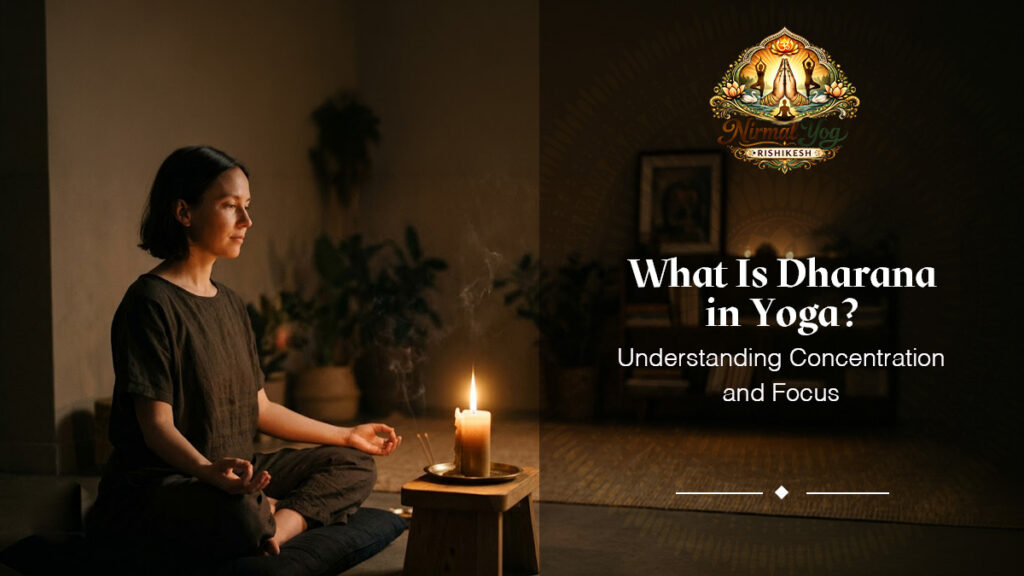
You sit down to meditate, shut your eyes and within seconds your mind is planning dinner replaying a conversation or checking a notification. This is precisely the problem that dharana in yoga addresses: not forcing the mind into silence but training it to rest on one chosen point.
Dharana-sometimes written dhāraṇā and frequently searched as dharna yoga is the limb of Patanjali’s eight-limbed path of yoga. In the Yoga Sutras Patanjali defines it as binding the mind to a place or object. It serves as the bridge between yoga practices and the deeper inner states of meditation.
Dharana Meaning in Yoga: Holding the Mind in One Place
The Sanskrit word dharana derives from the root dhri, which means “to hold ” “to support,” or “to maintain.” In yoga it refers to the effort to keep attention fixed on a single object: the breath, a mantra, a candle flame, a bodily sensation or an inner point of focus.
The dharana meaning in yoga is therefore not “concentration” in the everyday sense. You can concentrate while writing an email or driving through traffic. Dharana is far more intentional. It is the decision to pull attention away from the many competing thoughts and to place it over and over on a single point.
Patanjali’s definition is concise: desha bandhah chittasya dharana-concentration means binding consciousness to one place. The term “binding” is significant. The mind will wander; that is simply its nature. Dharana is the practice of noticing when the mind has wandered and bringing it back without frustration.
How Dharana Fits Within the Eight Limbs of Yoga
Dharana is the sixth of the eight limbs set out in the Yoga Sutras of Patanjali. It comes after the physical, breathing and sense-withdrawal practices and it readies the mind for meditation.
| LIMB | SANSKRIT NAME | FOCUS |
| 1 | Yama | values and how we relate to others |
| 2 | Niyama | Personal discipline and inner conduct |
| 3 | Asana | Steady comfortable posture |
| 4 | Pranayama | Control of breath and energy |
| 5 | Pratyahara | Drawing attention away from external distractions |
| 6 | Dharana | Focused concentration on a single point |
| 7 | Dhyana | Uninterrupted meditation |
| 8 | Samadhi | Profound absorption |
This order is helpful because it demonstrates that dharana does not arise all at once. Sitting still becomes easier with a posture. Breathing with control soothes the system. Pratyahara lessens the hold that sights and sounds have. Sustained concentration becomes realistic at that point.
Dharana, Dhyana and Samadhi: How Do They Differ?
A lot of students mix up dharana with meditation itself. This distinction is subtle.
- Dharana is concentration that takes effort: you pick an object. Keep returning the mind to it.
- Dhyana is meditation: attention moves toward the object with interruptions.
- Samadhi is absorption: the usual divide between the observer, the act of focusing and the object of focus grows less distinct.
One easy way to picture this is to watch a river. In dharana you repeatedly place your gaze on a stone in the stream. In dhyana the gaze stays there on its own. In samadhi the line between you and what you are observing grows softer.
These are not three techniques you can master over a weekend. They describe attention deepening by degrees. Traditional accounts often describe dharana as the stage dhyana as a more continuous flow of attention and samadhi as complete absorption.
Why Concentration Matters in Contemporary Yoga Practice
Most people come to yoga seeking flexibility, stress relief or physical health. Those benefits are genuine. Yoga’s deeper purpose also includes working with the mind. Dharana offers that inner work a place to begin.
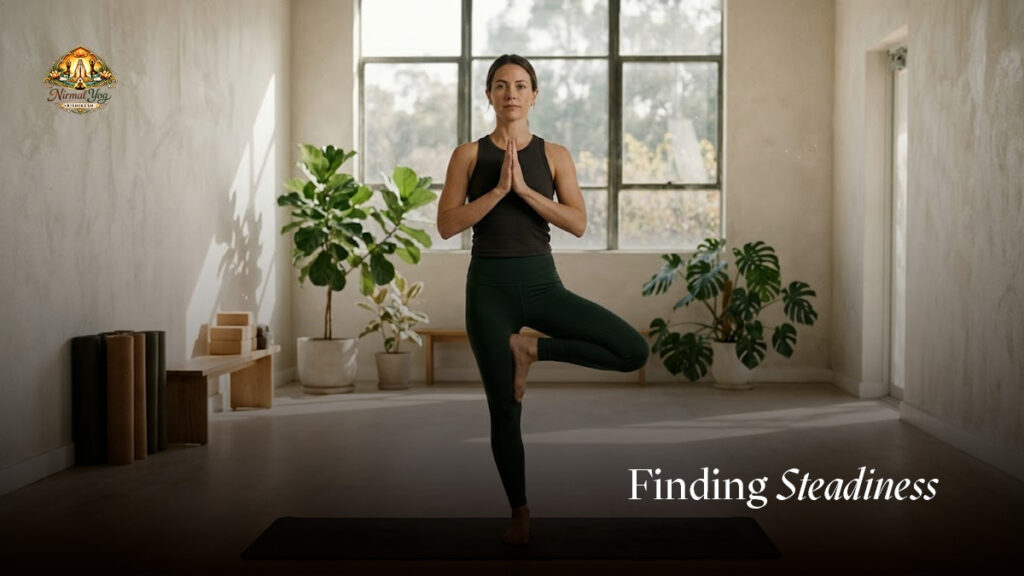
Think about something that commonly happens in a yoga class. In a balancing posture like Tree Pose your attention wanders to a wobbling ankle, someone or a thought about losing your balance. Soon as attention scatters, balancing gets more difficult. When you fix your gaze on a steady point in front of you the body usually steadies as well.
This is dharana in form: a single point of attention brings stability.
Beyond the mat this same ability shapes how you work, listen, study and handle stress. Someone who can bring attention back to a task is less easily drawn into reactive thinking. This is not to say that dharana is a productivity trick. Its traditional aim is clarity yet sharper focus is a natural by-product of practicing it.
Frequently Used Objects in Dharana Practice
There is no one “object” for concentration. The best option tends to be one that’s simple, neutral and easy to come back to.
- The breath: Watch the movement of air at the nostrils, chest or abdomen.
- A mantra: Silently repeat a word or phrase such as Om. Let your attention rest on its sound.
- A candle flame: Called trataka this external focus can help steady a restless mind.
- A body point: Some practitioners focus on the heart centre, the navel or the space between the eyebrows.
- A symbol: A yantra, an image or a simple object can act as a steady point of attention.
For beginners the breath often works better than an object. The breath is always there needs no preparation and makes it clear when the mind has wandered.
How to Practice Dharana: A 10-Minute Method
You don’t need an advanced meditation practice in order to start. What you need is consistency and the willingness to start over whenever attention drifts away.
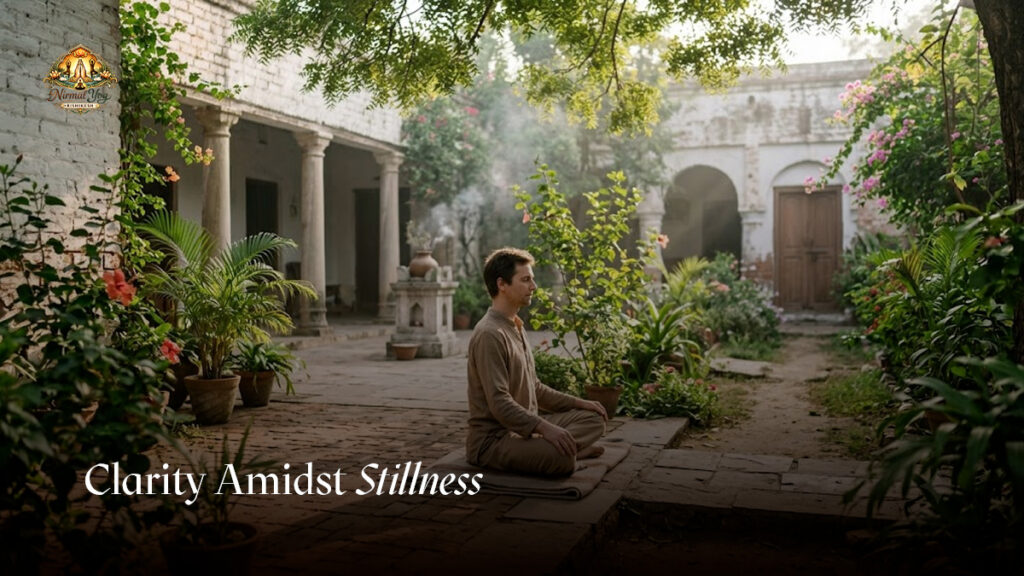
- Sit comfortably. Pick a posture in which the spine’s upright but the body is not strained. A chair works fine if sitting on the floor feels uncomfortable.
- Settle with the breath. Take a few breaths and allow the body to become still.
- Choose one focus. For instance, notice the cool air coming in through the nostrils and the warmer air going out.
- Keep your attention there. Do not try to control the breath or analyse it. Just observe it.
- Notice distraction without judgment. When a thought arises, recognize it. Return to the breath.
- End gently. After five to ten minutes expand your awareness, take a few breaths and observe how the mind feels.
At the beginning you might bring your attention back dozens of times within a few minutes. That does not mean you have failed. Every return counts as one repetition of the skill you are building.
Frequent Mistakes in Dharana Practice
The common mistake is taking a wandering mind as evidence that you are unable to meditate. In fact noticing that you have become distracted is itself part of the practice. The mind is meant to be observed, not punished.
Trying hard is another mistake. Effort helps. Gripping the mind usually produces tension. If frustration arises, soften your focus of giving it up.
Steer clear of these pitfalls:
- Chasing a completely empty mind. Dharana is about choosing where your attention rests, not wiping out every thought.
- Switching objects frequently. If you focus on the breath one day a mantra the next and a candle the day the mind has less opportunity to settle.
- Judging sessions as worthless. Five minutes of attention can be worth more than thirty minutes of strained sitting.
- Mistaking relaxation for concentration. A calm body is helpful. Dharana also requires a clear alert quality of attention.
How Dharana Supports Meditation and Everyday Life
Dharana is frequently referred to as the training ground for meditation. Without some capacity to hold attention meditation can feel like sitting with a stream of thoughts. Through dharana the mind gradually becomes less fragmented.
The benefits show up in life. A student studying for a test might find it easier to go to the page after getting distracted. A parent might react less when interrupted. A worker might pay attention during a talk instead of thinking about what to say next.
These changes do not happen at once and they should not be seen as something amazing. But when you practice again and again your mind gets used to a path: distraction happens, awareness sees it and attention comes back.
Dharana in a Yoga Retreat Setting
For people a yoga retreat in Rishikesh offers a place where dharana is easier to feel. The regular pattern of yoga postures, breathing exercises, meditation and a calmer atmosphere lowers the number of things that take attention.
That does not mean attention becomes automatic. In a quiet place the mind still has its usual habits. When outside noise is less students often see their thoughts more clearly and understand that they can decide where their attention goes.
This is the use of dharana in yoga: it makes meditation something you can watch and improve over time.
Final Thoughts
Dharana is not about making the mind quiet on command. It is about learning how attention works: where it goes, why it moves and how it can be gently brought back. That simple act of coming is the heart of dharana in yoga.
When done regularly dharana helps the mind get ready for meditation. Adds a calmer more focused way of being, to everyday life. Start small, choose one thing to focus on and see each distraction as a chance to begin again.
Frequently Asked Questions
Dharana is concentration in yoga: the act of keeping the mind focused on one thing you choose like the breath, a word or a flame.
Not exactly. Dharana is about focusing and usually takes effort. Dhyana or meditation is an easier flow of attention that can come from dharana.
“Dharna” is another way to write dharana. In yoga it means tying or keeping the mind on one point.
Yes. Beginners can start with five to ten minutes of focusing on the breath gently bringing attention back whenever it drifts.
The breath is usually the place to begin. A word, a flame, a body feeling or a picture can also help keep attention steady.