

Think about the last conversation in which you edited yourself. Perhaps you changed the sentence before saying it, laughed to make it sound less serious, or decided that silence would be easier. Most people have done this. Communication is rarely a simple matter of having something to say.
This is what makes Blue Aura and Throat Chakra Healing worth exploring. Both ideas are associated with truth, listening and expression, but their value goes beyond colour symbolism. They invite us to notice the distance between what we feel, what we understand and what we finally allow ourselves to say.
Yoga links this inquiry with Vishuddha, the throat chakra. Aura traditions often describe blue as a sign of calmness, sensitivity or clear communication. Used thoughtfully, the two frameworks can help someone examine their voice without turning ordinary emotions into a spiritual diagnosis.
What a Blue Aura Means
The Blue Aura Meaning is commonly connected with sincerity, reflection, intuition and the ability to communicate with care. A person associated with blue may be described as a good listener or someone whose presence feels steady. Those descriptions can be useful, provided they remain symbolic.
An aura is not a clinically measurable record of personality or health. Two people may both appear quiet while experiencing completely different things. One may be listening closely. The other may be afraid that speaking honestly will cause conflict. Behaviour alone does not explain the reason behind it.
The Blue Aura Spiritual Meaning becomes more useful when treated as a question rather than a label. Where does your communication feel natural? Where do you become vague, overly careful or unexpectedly defensive? Blue, in this context, offers an image for reflection. It does not provide a verdict about who you are.
How the Blue Aura Connects with Vishuddha
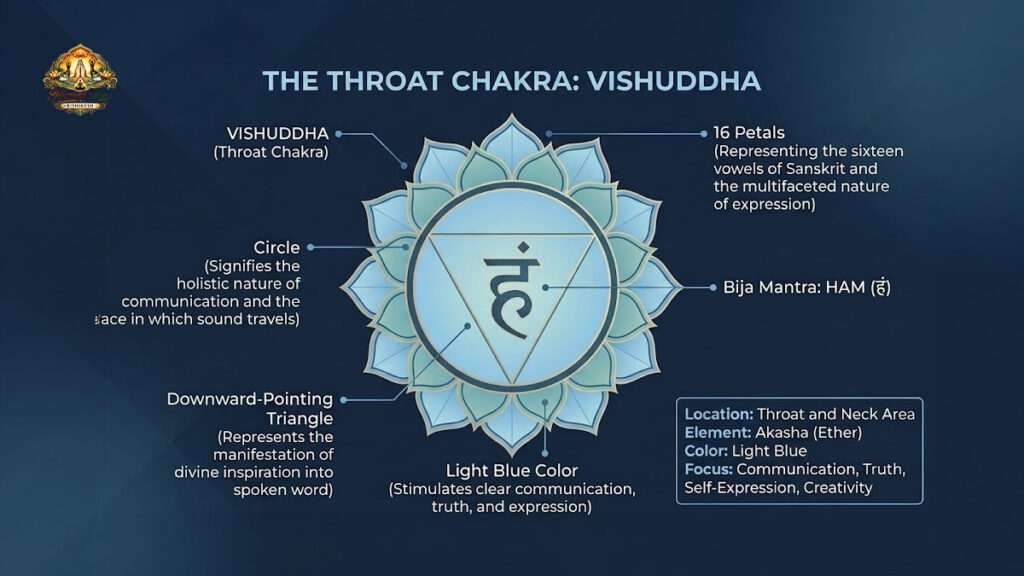
Vishuddha is commonly described as the fifth chakra, located around the throat. Its Sanskrit name is often translated as purification, and contemporary chakra teachings associate it with the colour blue and the element of space.
The link between a blue aura and the throat chakra comes from a shared concern with honest expression. In practice, that includes much more than speaking confidently. It also covers listening, choosing words carefully, stating a need, setting a boundary and knowing when silence is deliberate rather than fearful.
Consider a familiar example. Someone may lead meetings with ease yet struggle to tell a close friend that they feel hurt. Another person may write clearly but freeze during confrontation. Communication changes with context, history and perceived safety. A simple open-or-blocked label misses that complexity.
Listening belongs to throat chakra practice
Throat chakra discussions often concentrate on finding your voice. Listening deserves equal attention. Speaking without taking in another person’s response can become performance; listening while never expressing yourself can turn into self-erasure.
A steadier form of communication moves between the two. It allows time to hear, consider and respond without disappearing from the conversation. This is why silence, pauses and observation may belong in Throat Chakra Healing alongside mantra and sound.
Communication Patterns Often Called Throat Chakra Signs
Online lists of Throat Chakra Signs can be too certain. A reserved person is labelled blocked, while an outgoing speaker is assumed to be balanced. Real communication is less tidy. What matters is the pattern, the setting in which it appears and what it prevents you from saying or hearing.
Patterns worth observing include:
- agreeing automatically when you want to say no;
- avoiding a necessary conversation until resentment builds;
- giving long explanations for a simple boundary;
- speaking quickly when you feel judged or interrupted;
- using jokes or hints instead of making a clear request;
- listening mainly to prepare your reply;
- feeling misunderstood even after repeating the same explanation.
None of these experiences proves that a chakra is physically blocked. They are prompts for self-study. Persistent pain, voice changes, swallowing problems or emotional distress need appropriate professional care; yoga practice should not replace medical or psychological support.
How to Support the Throat Chakra in Practice

A balanced approach to heal throat chakra involves more than one technique. Gentle yoga, mindful breathing, honest communication, and feeling safe enough to express yourself can support a healthier relationship with your voice and emotions.
Notice the jaw neck and shoulders
The body often reacts before the words arrive. The jaw tightens. The shoulders lift. Breathing becomes shallow. Gentle neck movements, shoulder rotations, supported chest openers and careful spinal mobility can make these habits easier to notice.
Simhasana, or Lion Pose, may also be used to explore the face, jaw, exhalation and sound. There is no need to force an emotional release. The practical question is simpler: what happens in your body when you expect to be heard, challenged or judged?
Study the connection between breath and voice
Speech rides on the breath. When breathing is hurried, the voice may sound strained or the sentence may run ahead of the thought. Bhramari uses a soft humming exhalation that brings attention to vibration around the face and throat. Ujjayi works with a gentle narrowing at the back of the throat, though it is best learned without creating a harsh or theatrical sound.
Beginners do not need long breath retention or intense techniques. Ease and consistency reveal more than effort. If a practice causes dizziness, strain or anxiety, it should be stopped and discussed with a qualified teacher.
Use sound without worrying about performance
The seed sound commonly associated with Vishuddha is Ham. Chanting, humming or reading aloud can help a participant feel how sound moves through the breath and throat. The interesting part is often the reaction: embarrassment, hesitation, the urge to copy another voice, or relief at making sound in a room where nobody is judging its quality.
A polished voice is not the goal. The practice is learning to stay present while your own voice is audible.
Bring the practice into ordinary conversations
The clearest test happens away from the mat. Can you make a direct request instead of hoping someone will guess? Can you disagree without insulting the other person? Can you say no without writing a full defence of your decision?
Small exercises help. Pause before answering. Repeat what you heard before giving your view. Write the sentence you are avoiding, then remove the blame and extra explanation. These habits may look ordinary, but they give throat-centred practice a place in real life.
What a Throat Chakra Retreat Can Offer
A thoughtfully planned Blue Aura and Throat Chakra Healing retreat may combine asana, pranayama, meditation, chanting, journaling and quiet periods. The schedule matters less than the way those practices speak to one another.
A morning movement session may reveal tension in the shoulders. Chanting may bring up discomfort with being heard. Later writing can help name what has remained unsaid. Meditation then creates room to observe the reaction without rushing to fix it. Several days of returning to the same theme can show connections that a single class may not reveal.
Why Rishikesh Suits This Kind of Enquiry
Rishikesh offers a setting where yoga, breathwork, mantra, meditation and philosophy are often taught as related disciplines. Time away from normal roles also changes the conditions in which communication is observed.
At home, familiar relationships can pull us into familiar responses. A retreat interrupts that rhythm. With fewer messages to answer and a more deliberate daily structure, participants may notice when they withdraw, over-explain, interrupt or avoid asking for help.
A responsible retreat will not promise to repair every communication difficulty. It can provide time, guidance and repeated practice. Before booking, ask what methods are included, whether beginners are welcome, how practices are adapted and what the organisers mean when they use the word healing.
Final Thoughts
Blue is often described as the colour of calm expression. Yet an honest voice is not always calm or elegant. It may tremble during a necessary conversation. It may need to say no. At other times, it may choose to listen instead of filling the silence.
That is the grounded value of Blue Aura and Throat Chakra Healing. The practice helps you notice what changes your voice, what makes you hide it and how you listen when another person uses theirs. A good retreat does not hand you a new voice. It gives you time to hear the one you already have more clearly.
Frequently Asked Questions
Blue is most commonly associated with Vishuddha, the throat chakra. Both are symbolically connected with communication, truth and listening, although aura traditions and the yogic chakra system are not exactly the same framework.
People often report difficulty stating needs, fear of disagreement, unclear boundaries, impulsive speech or a repeated sense of being misunderstood. These patterns can guide reflection, but they are not medical evidence of a blocked chakra.
Teachers may use gentle neck and shoulder mobility, Simhasana, supported chest openers, Bhramari, meditation, mantra and communication exercises. The choice should reflect the participant’s health, experience and comfort.
There is no standard timeline. Communication habits often develop over years and change through repeated practice, safer relationships and honest conversations. A retreat may begin that work, but it cannot promise a fixed result.